Mary Senkowska
The Engagement Crisis: How Leaders Can Turn the Tide Through Well-Being and Purpose
Global employee engagement has plummeted to just 23%, costing the economy $8.9 trillion annually. Discover why traditional productivity fixes fail and how leaders can leverage neuroscience—specifically dopamine and purpose-driven motivation—to create sustained engagement. Learn practical strategies to transform team culture through understanding intrinsic motivation, building trust, and embedding purpose into daily leadership conversations.
The Engagement Crisis: How Leaders Can Turn the Tide Through Well-Being and Purpose
After a few years of small but steady gains, employee engagement and wellbeing have decreased significantly, posing now as one of the main concerns for leaders globally. Gallup’s ‘State of the Global Workplace: 2024 Report’ found that the global average is just at about 23%, with the U.S. and Canada placing about 10 percentage points higher, and Europe 10 percentage points lower, ranking last among all regions, with just 13%. You may think that give or take 30% is not that bad.. so let me put it into perspective. The same report estimates it costs the global economy $8.9tn, or 9% of the global GDP — enough to make a difference between success and failure for some of the world’s development goals.
Evaluating the situation from the cost perspective, I came across the research released this year by Cebr (Centre for Economics and Business Research) that expects the cost of long-term sick leave to almost double by 2030, costing $86.13bn a year in lost productivity. You may ask what does that have to do with employee engagement? Well, out of 112.5m sick days taken, 44% of absences were caused by mental health. And even though not all mental health issues are related to work, work is a factor in life evaluations and daily emotions. The bottom line is, that you can’t have engaged and thriving employees if they struggle with well-being day in and day out.
In the more and more complex world, we all have to navigate significantly higher amounts of data, change, and what comes with it, often, stress. The state of overwhelm, fatigue and overstimulated nervous system hinder our capacity e.g. decision-making, confidence, feeling a sense of fulfillment, and in turn, motivation. And with that, the role of a leader is shaping to be different from what we have known it to be for the past 20-30 years. This is why I believe that emotional management has become one of the core leadership skills, and leaders who invest in their self-awareness are going to be the most in-demand in years to come.
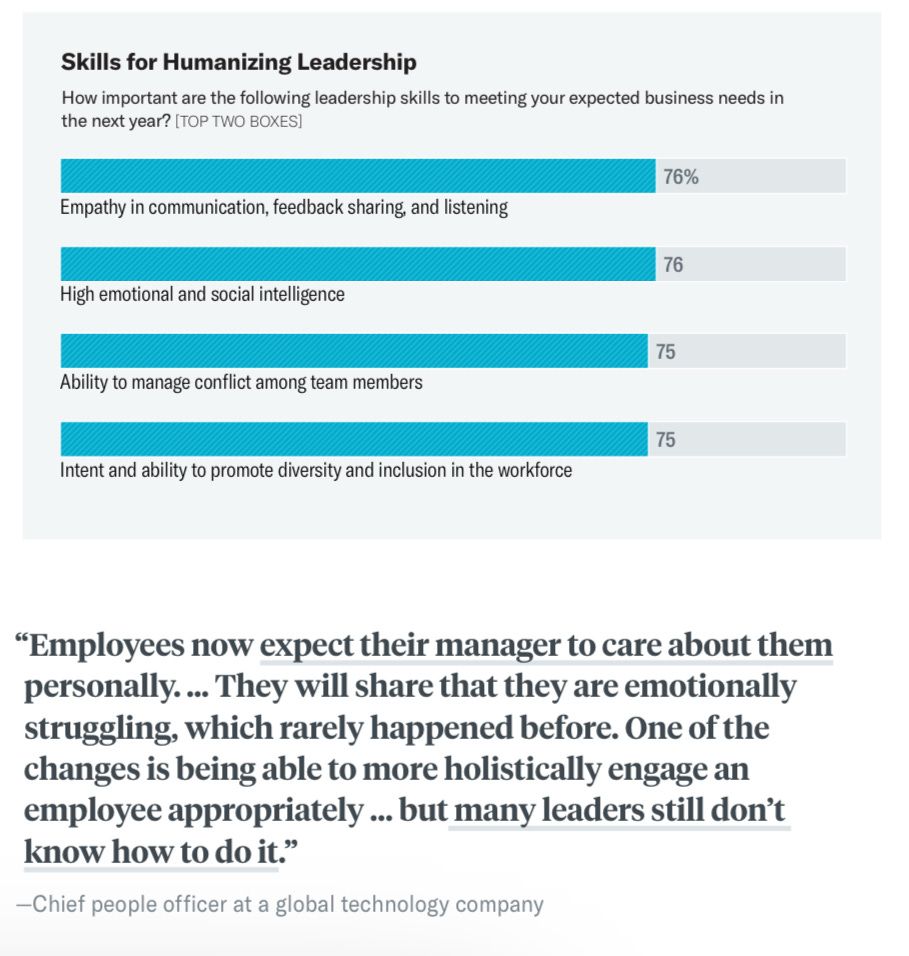
The biggest problem we have currently is — we don’t understand ourselves. This is why we try to address low engagement rates with more tools and training focused on efficiency and productivity, jumping to the conclusion that it’s a matter of a system and organization. We bet on short-sighted solutions when the goal is to create sustained engagement. Instead of fixing the behaviors, we should understand what drives them.
Where do motivation and engagement come from?
It is an often-quoted fact that motivation is driven by dopamine. And it is not wrong, per se. However, not nearly as often is this presented in a broader context. We’d oversimplify if we focused solely on it. Yet, we don’t do ourselves any favors when we don’t apply what we know about dopamine to create better systems for productivity and engagement. Dopamine doesn’t work in a vacuum and we’re not just at the mercy of it.
The science behind:
Dopamine is a neurotransmitter, meaning it facilitates communication between nerve cells in your brain and the rest of your body. It is involved in memory, attention, cognition, mood, sleep and arousal, motivation, any kind of smooth movement like waving your arm, and even learning.
Our ability to produce dopamine can be hindered by e.g. stress, sleep deprivation, substance abuse, or, according to some researchers, diets, saturated fat intake, and obesity. On the flip side, we can stimulate its production through regular exercise, music, meditation, getting enough sunlight, or an appropriate diet.

How to use this in my leadership?
Here is where I’d like to make an observation that this so-called „self-care”, that is often dismissed or deprioritized, is not only to favor our personal lives but has a real impact on your drive to maximize your potential. So if you ever thought to yourself that certain simple activities like protecting your teammates' time to take a walk during lunch is a nice-to-have, I hope this article will show you that we, humans, are holistic beings and neglect in one area will surely impact the other parts of our holistic system. Thus, mental health and the well-being of your team should be an integral part of your team development goals.
If you’d like to discuss in more detail how to adapt your current development programs to integrate mental health, reach out to me. Creative Brain offers tailored consultancy services to help you help your people. Your team becoming more balanced and less stressed will contribute to your team's culture, productivity, and creativity.
What motivates us best?
Research demonstrates a significant effectiveness gap between extrinsic and intrinsic motivation in the workplace. Studies show that intrinsic motives have three times the impact on employee engagement levels compared to extrinsic motives.
McKinsey research revealed that intrinsically motivated employees show 46% higher levels of job satisfaction and 32% greater levels of commitment to their jobs.
While extrinsic rewards like bonuses can provide short-term compliance and immediate behavioral changes, they often create what researchers call the "undermining effect"—where external rewards actually diminish long-term motivation once removed. Meta-analysis research indicates that there is less than 2% overlap between pay and job satisfaction levels, highlighting that financial incentives have minimal impact on sustained engagement.
In contrast, intrinsic motivation—driven by purpose, autonomy, and mastery—creates lasting behavioral change, enhanced creativity, and sustained high performance, making it the superior approach for complex knowledge work and long-term organizational success.
McKinsey research revealed that intrinsically motivated employees show 46% higher levels of job satisfaction and 32% greater levels of commitment to their jobs.
While extrinsic rewards like bonuses can provide short-term compliance and immediate behavioral changes, they often create what researchers call the "undermining effect"—where external rewards actually diminish long-term motivation once removed. Meta-analysis research indicates that there is less than 2% overlap between pay and job satisfaction levels, highlighting that financial incentives have minimal impact on sustained engagement.
In contrast, intrinsic motivation—driven by purpose, autonomy, and mastery—creates lasting behavioral change, enhanced creativity, and sustained high performance, making it the superior approach for complex knowledge work and long-term organizational success.
The science behind:
Honing in on motivation then ... The dopaminergic system functioning as our “reward center”, is more stimulated when anticipating pleasure as opposed to actually experiencing it. And it has the stunning power to reinforce behaviors. As humans, we are hard-wired to seek out these behaviors, which release dopamine. Unfortunately, often, we skew towards extrinsic rewards, which have short-lived effects.
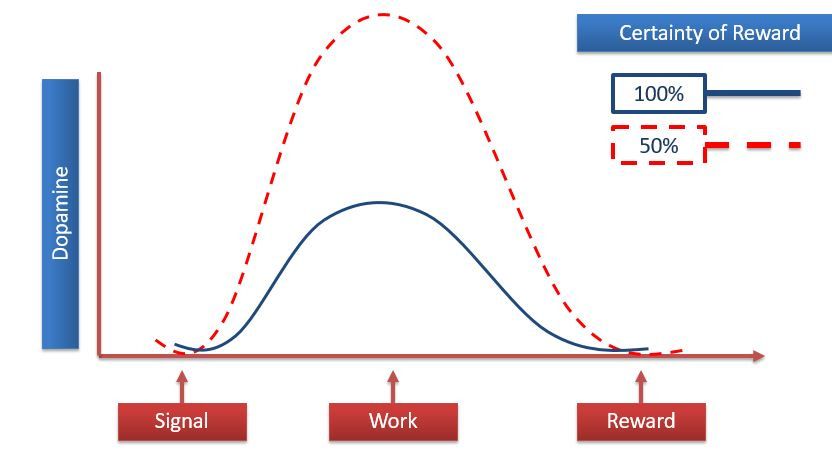
If the reward (which can be a gain or avoided loss) is closely connected with intrinsic motivations or specific goals, anticipation, and thus, likely sacrifice, is high. If it’s disconnected from our interests, or it is unclear, expect the opposite effect.
How to use this in my leadership?
That means, first of all, dopamine has an instantaneous effect and is not meant to last. It fires when triggered. So building motivational systems that are solely based on extrinsic, short-lived, motivators or introducing performance reviews solely reliant on long-term goals, checked upon once a year, and expecting sustained engagement are simply an example of a mismatched action and objective. Extrinsic rewards may work well for compliance matters, but it’s the intrinsic motivation that you need to inspire true engagement.
At the same time, expecting our team to be constantly highly motivated is unrealistic and can lead to a toxic team culture which often results in burnout. It can propel a vicious cycle where our reaction to lack of motivation is a quick fix, that obviously won’t last (just because of how our biology works), which sends us/your employees into a spiral of feeling guilty that they are not motivated and not doing enough, that breeds self-doubt, often causes them to withdraw, and ultimately leaves them with a sense of giving up. Thus, we need to focus on building a team culture based on trust, where we listen to understand and not assess.
Secondly, as leaders, we have the responsibility to know what the true motives of our team members are. And, that goes beyond knowing they want the next promotion. We need to learn how to ask better questions. What do your employees value? Is it about recognition, status, or a way to prove themselves? A challenge, or puzzle to solve? A particular skill? More time? Responsibility or independence that they crave? Knowing their values, and personal purpose and checking up on how that Purpose evolves together with their growth and development in the organization is core to crafting the right communication, strengthening trust, and inspiring ownership in them.

Dopamine does give us pleasure, but not contentment.
Neuroscience reveals that happiness is primarily mediated by the neurotransmitter acetylcholine and occurs only in a state of safety, while pleasure is driven by dopamine and can occur in both safe and threatening contexts.
Pleasure means something we want because it feels good temporarily, creating a cycle where 'want' becomes 'need,' while happiness means contentment—feeling good and satisfied without needing more.
Research demonstrates that dopamine's role has shifted from being seen as a direct pleasure creator to functioning more as a motivational force that reinforces remembering and repeating experiences. This explains why dopamine-driven rewards create temporary highs followed by the need for more stimulation, whereas true contentment emerges from neurochemical states involving serotonin and GABA that promote lasting satisfaction.
Understanding this distinction is crucial for leaders seeking to build sustainable engagement rather than short-term behavioral compliance.
Pleasure means something we want because it feels good temporarily, creating a cycle where 'want' becomes 'need,' while happiness means contentment—feeling good and satisfied without needing more.
Research demonstrates that dopamine's role has shifted from being seen as a direct pleasure creator to functioning more as a motivational force that reinforces remembering and repeating experiences. This explains why dopamine-driven rewards create temporary highs followed by the need for more stimulation, whereas true contentment emerges from neurochemical states involving serotonin and GABA that promote lasting satisfaction.
Understanding this distinction is crucial for leaders seeking to build sustainable engagement rather than short-term behavioral compliance.
How to use this in my leadership?
Don’t chase the wrong thing. Purpose is the space where sustained engagement is born and nurtured. It turns out that the frequency of Purpose-oriented conversation is also important. Why? As we collaborate with others just focused on the efficiency of achieving the goal, our biological default is the threat response. It is easily triggered and has more lasting effects than the reward response. Leaders are better off running the risk of being a broken record than stating employees’ connection to a higher purpose too few times.
Organizations and their leaders need to embed employees’ connection to a higher purpose into the everyday conversation of the organization — whether it be memos, manuals, brand stories, collateral, or office dialogue. It awakens the desired reward response and the associated levels of positive engagement that ultimately drive business performance.
Organizations and their leaders need to embed employees’ connection to a higher purpose into the everyday conversation of the organization — whether it be memos, manuals, brand stories, collateral, or office dialogue. It awakens the desired reward response and the associated levels of positive engagement that ultimately drive business performance.
To lead with purpose, invest in building skills like impactful communication, trust building, and executive presence. You may want to consider 1:1 coaching. Over the years, I have specialized in grounding executives’ leadership skills in self-awareness, which brings the most far-reaching effects on overall leadership acumen. Through coaching, you can also work on developing your authenticity and invest time to understand how your organization’s mission and strategic objectives align with the team goals and personal motives of each team member.
"You can’t effectively manage what you’re unaware of."

What's your role in that process as a leader?
Motivation to act requires some expectation of success. If skills and talents are thought of as fixed—something people either have or don’t have—an initial failure is likely to be attributed to a lack of natural ability and, in turn, may decrease motivation. But if skills and talents are seen as capacities that can be developed through practice—a growth mindset— then a failure signals the need to develop the skill or talent through continued effort and practice.
How to use this in my leadership?
Watch out for how you speak. As a leader, you construct a certain narrative. Starting from random comments referring to what you emphasize when you compliment your team and what you highlight when you talk about the failure. How do you speak about efficiency? What is the narration around problems in your team? Talking about them can be extremely productive if we navigate the discussion towards achieving emotional catharsis, where we feel the emotions, understand them, and use them to sift our perspective.
Lastly, your confidence as a leader matters a ton. If you focus on results and outcomes only and are not able to project an authentic expectation of success, people will pick up on it subconsciously. And of course, failures are unavoidable and a crucial part of the growth process. Thus, focusing on rewarding healthy behaviors in the team, and seeking success in the way you handle situations is a great way to shift your confidence locus of control, which in turn should spark higher perceived confidence among your team members.
The Neuroscience-Leadership Connection: Your Path Forward
Engagement challenges are fundamentally different from operational inefficiencies—they require a deeper understanding of human psychology and the neurobiological drivers of motivation. As this research demonstrates, traditional quick fixes fail because they don't address the underlying neural patterns that create sustained engagement.
The transformation begins with you. Leaders who understand how dopamine, purpose, and intrinsic motivation interact in the brain are uniquely positioned to create the conditions where their teams naturally thrive. This isn't about implementing another productivity system—it's about rewiring your approach to leadership through scientific understanding.
Your next step is strategic consultation. In a complimentary 30-minute session, we'll assess your specific engagement challenges and design a neuroscience-based development path tailored to your leadership context. Whether through our certification programs, 1:1 executive coaching, or targeted workshops, we'll identify the most effective approach to transform your leadership impact.
The global engagement crisis costs $8.9 trillion annually, but the solution starts with individual leaders who are willing to evolve their approach. The question isn't whether your team's engagement will improve—it's how quickly you're ready to lead that transformation.
Good luck!
Mary
Stay connected
Subscribe to receive our latest research insights, practical frameworks, and leadership strategies delivered directly to your inbox. Join a community of leaders who are transforming their effectiveness through neuroscience-informed approaches.
Thank you!
Stay up-to-date
Training Calendar

Created with